
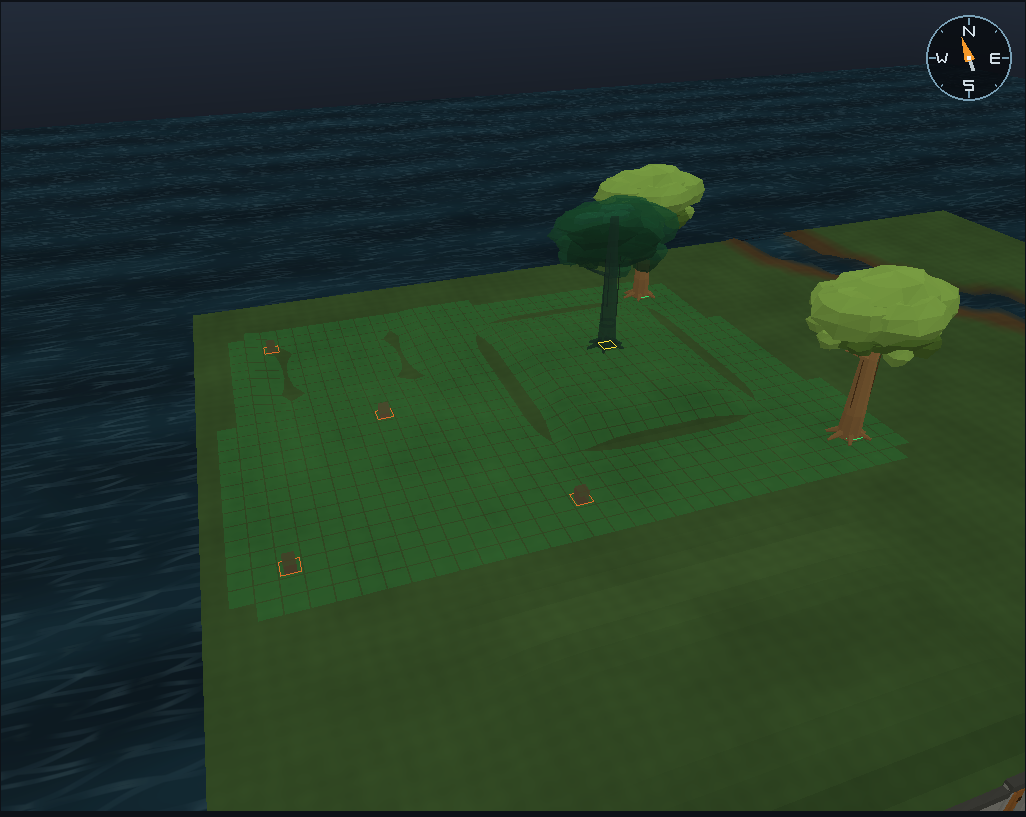
Below is a revised version of the full post, integrating the current Resource Pool implementation, placement-specific depletion behaviour, Mining support, shared gathering curves, and exceptional permanent resources. It replaces the earlier draft rather than adding a dated appendix.
Resource Pools and the Future of Gathering
Development on Guardfall’s World Editor is now approaching the point where we can spend less time proving that the world can be built, and more time deciding what players will actually do inside it.
One of the first systems to take advantage of the new World Editor is gathering.
As a concept we want to experiment with, we have introduced a system called Resource Pools.
Resource Pools are optional gathering areas designed to make the part of the world you are training in feel more active. They encourage players to move around, become familiar with the surrounding area and pay attention to changes taking place nearby.
At the same time, we recognise how irritating it would become if every gathering method forced players to move whenever a resource was depleted.
That is why it is important to explain the difference between Resource Pools and Static Resources, how the two can behave differently, and the role each is intended to fill.
What Is a Resource Pool, and How Does It Work?
For this example, we will use a grove within a larger woodland area.
When we say “grove,” we are talking about an area containing 25 possible tree locations, with 12 trees active at any given time.
A Resource Pool is essentially what it says on the tin: a larger gathering area containing a collection of possible resource locations, where there may be X possible locations, but only Y active resources at once.
Using our grove as an example:
- X is 25: the total number of possible tree locations.
- Y is 12: the number of trees that can be active at the same time.
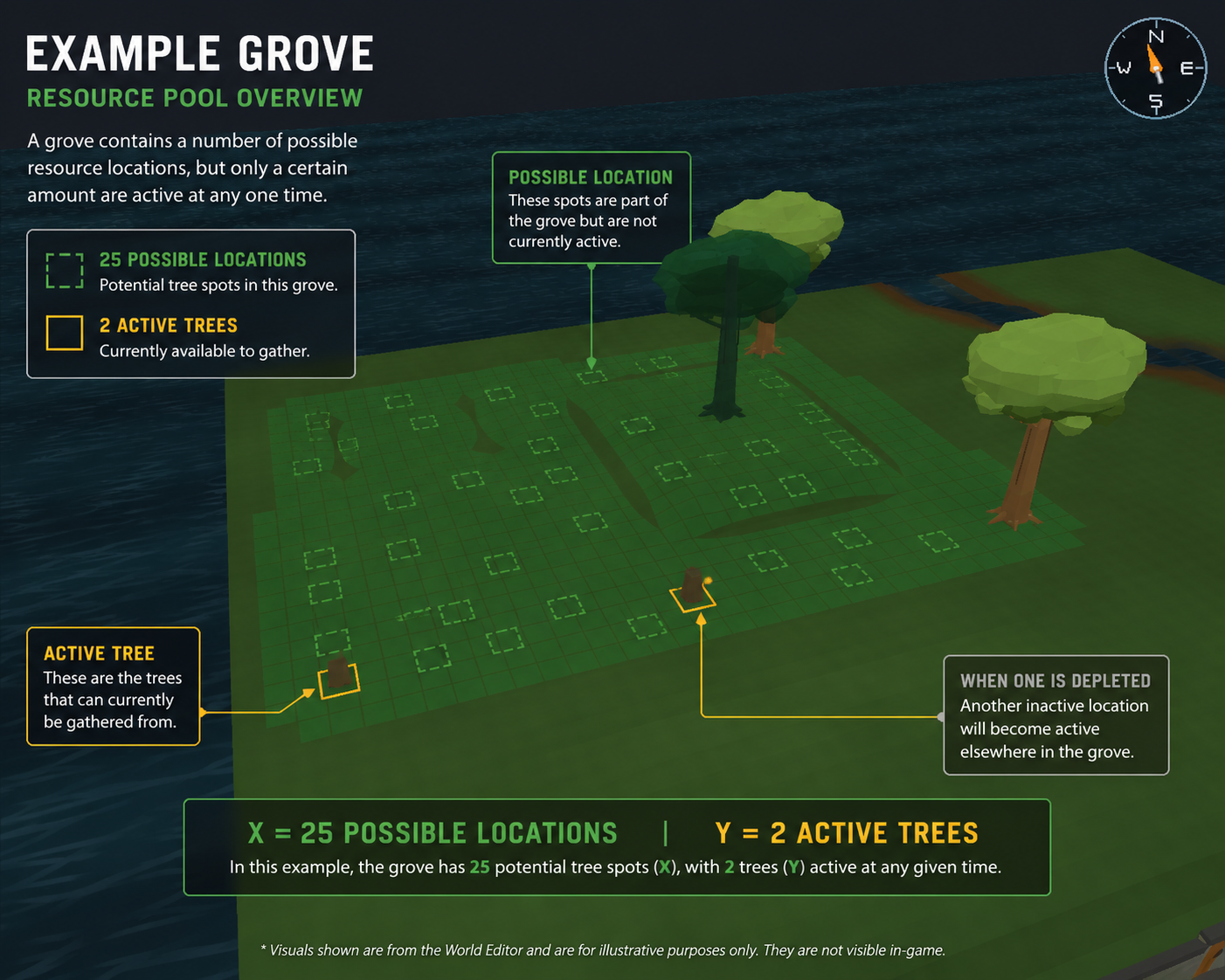
When one of those trees is depleted, another inactive location within the grove may become active.
Rather than remaining beside the same tree indefinitely, players will gradually move around the area as different parts of the grove become available.
This does not mean walking across the world after every resource.
Players remain within the same recognisable woodland, mine, shoreline or gathering area. The active resources within that area simply change over time.
Shared Resources
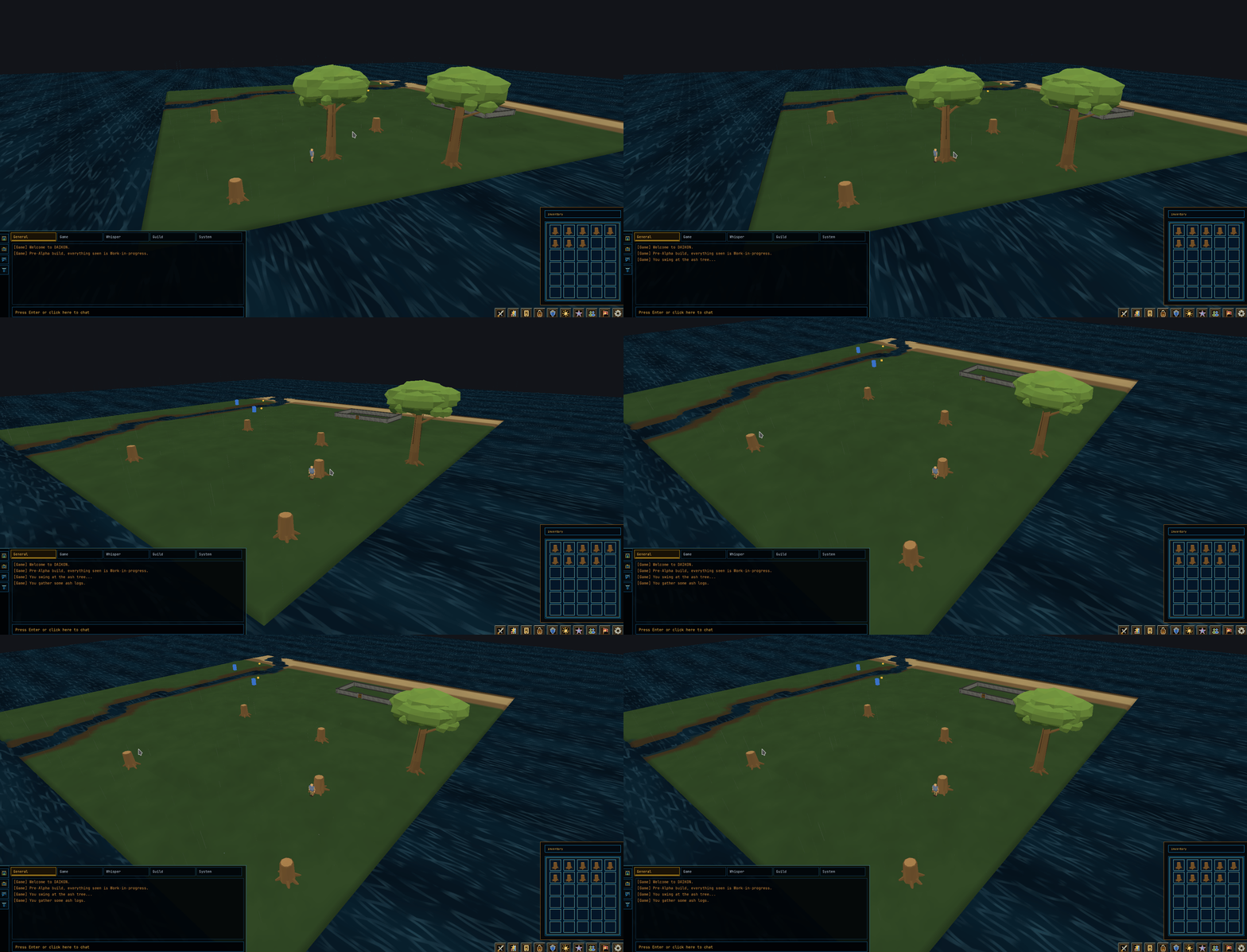
Resources within a pool are shared world objects.
If several players are cutting the same tree, they are interacting with the same tree and contributing to the same shared lifecycle.
Adding more players does not make a timed resource expire more quickly. Several players can keep the resource active, but its timer still progresses at the normal rate.
This avoids a situation where a popular gathering area becomes frustrating simply because several people are using it.
The resource remains shared, but additional players do not multiply the speed at which it disappears.
The same principle applies to resources that contain a fixed number of successful gathers. That amount belongs to the world object itself rather than being tracked separately for each player.
For example, if a Static Resource contains eight successful logs before depletion:
- one player could gather all eight;
- two players could gather four each;
- one player could gather five and another gather the remaining three.
Once the shared amount has been gathered, the resource becomes depleted for everybody.
Learning the World Through Gathering
One of the main goals behind Resource Pools is to help players learn the layout of Guardfall’s world naturally.
A player may begin by recognising one or two convenient trees. Over time, as resources become active in different parts of the grove, they will become more familiar with the wider woodland.
They may begin to recognise:
- nearby paths and shortcuts;
- landmarks;
- entrances to other areas;
- local dangers;
- nearby towns or villages;
- other useful resources and activities.
This familiarity develops while the player is already doing something they intended to do.
We do not want every piece of exploration to be driven by a marker, arrow or direct instruction. Sometimes the world can teach players how it is connected simply by giving them a reason to move through it.
The intention is not to force players to wander aimlessly. Resource Pools should remain clearly defined gathering areas, with movement appropriate to the size and shape of the area.
A small roadside grove may keep its active trees close together. A larger woodland may spread them between several nearby clearings. A mine could encourage movement between connected chambers, while a fishing area may use several points along the same stretch of water.
The purpose is familiarity, not inconvenience.
Resources That Belong in the World
Resource Pools are not intended to divide the world into rigid skill-level zones.
The resources found within an area should make sense for that environment.
A grove beside a river may naturally contain willow trees, while a woodland further inland may contain a different mixture. Mining resources can reflect the cave, mountain or region in which they are found, while fishing resources can depend on the surrounding water.
This means a Resource Pool may contain resources with different requirements, not because it has been deliberately labelled as a particular training bracket, but because those resources belong together in that part of the world.
Common trees, which serve as Guardfall’s introductory Woodcraft resource, will be found throughout much of the world. Players should rarely need to travel far simply to find a basic tree to cut.
More specialised resources may be associated with particular environments.
A player looking for willows may learn to search near water. Another resource may be associated with a particular climate, region or type of terrain.
The goal is for players to learn where resources are likely to appear by understanding the world around them, rather than memorising a sequence of designated training zones.
Compensating for Movement
Moving between active resources naturally creates short periods where the player is not gathering.
Resource Pools are not intended to punish players for that movement or leave them progressing noticeably slower than somebody standing beside a single resource.
While gathering within a pool, players may receive passive benefits designed primarily to compensate for the time spent moving between nodes.
These may include adjustments to experience, occasional additional resources and a lower likelihood of encountering disruptive gathering conditions.
The purpose of these benefits is not to make Resource Pools dramatically more efficient than every other gathering method.
They exist to recover the time lost while moving and keep progression broadly comparable with gathering from a resource that always returns in the same place.
A player using a pool may spend part of their time walking between resources. A player using a Static Resource avoids that movement entirely.
Both should remain reasonable ways to train.
Activity Within Resource Pools
Compensating for movement is only one part of the system.
Resource Pools also give us more room to make gathering areas feel active.
While using one, players may notice temporary changes affecting individual resources or the surrounding area. Some of these changes may be beneficial, while others may be disruptive.
A player paying attention may be able to respond to a brief opportunity, complete an action more quickly or receive a temporary benefit to their gathering.
Other changes may interrupt the normal rhythm of the area or create a situation the player needs to react to.
These interactions are intended to occur often enough that an attentive player will encounter several of them during a gathering session, without turning the skill into a constant sequence of prompts.
The player should still primarily be cutting trees, mining rocks, fishing or gathering another resource.
The surrounding activity adds brief moments of interaction around that familiar loop.
We are deliberately keeping the exact details private for now. Some ideas are already being considered, but we would rather reveal individual interactions once they have been implemented and tested properly.
The broader intention is that Resource Pools provide more than a changing list of active objects.
They should:
- encourage movement;
- reward awareness;
- interrupt completely unattended repetition;
- provide occasional opportunities;
- make gathering areas feel like active parts of the world.
Both beneficial and disruptive interactions contribute to that design.
A positive opportunity can encourage a player to notice that something has changed just as effectively as a negative interruption. This gives us a wider range of ways to keep gathering responsive without relying entirely on punishment.
Static Resources
Not every resource in Guardfall will belong to a pool.
Some gathering objects will remain fixed in the world. These are what we currently refer to as Static Resources: trees, rocks, fishing locations and other gathering nodes that return in the same place after being depleted.
Static Resources are intended for players who prefer a more predictable and relaxed way of gathering.
A player may want to train while chatting, watching something, listening to music or simply paying less attention to the game.
They may also be unfamiliar with an area and want a dependable location where they can learn the basic gathering loop without needing to follow changing resources around the map.
With a Static Resource, the player knows where it is, what it provides and where it will return.
That reliability is the role these resources fill.
They may commonly appear:
- near settlements and starter areas;
- beside roads and recognisable landmarks;
- around workshops, farms and fishing villages;
- in locations tied to quests or specific pieces of content;
- anywhere a permanent location makes more sense than a larger gathering pool.
Static Resources are not intended to be deliberately weak or frustrating.
They provide a dependable alternative for players who do not want the movement or additional activity offered by a Resource Pool.
However, they will not receive the positive opportunities or movement-compensating effects available within pooled gathering areas.
Because the resource always returns to the same place, there is no travel time to compensate for.
Static Resources may still be affected by occasional disruptive gathering conditions. These are intended to discourage completely unattended repetition and ensure that even the more relaxed gathering option still requires some level of player awareness.
Their behaviour will generally remain simpler and more predictable than that of a Resource Pool.
Different Behaviour in and Outside Pools
A major part of the current implementation is that the same resource can behave differently depending on where it has been placed.
A tree inside a grove may use timed depletion. Once players begin successfully gathering from it, it remains available for a shared period of active cutting before becoming a stump.
The same type of tree outside a grove may instead contain a fixed number of successful logs.
For example, an ash tree could currently be configured so that:
- inside a grove, it remains active for 30 seconds of shared cutting;
- outside a grove, it provides eight successful shared logs before becoming a stump.
Both use the same ash-tree definition, rewards and Woodcraft requirements. The difference comes from whether the tree belongs to a Resource Pool.
When the pooled tree is depleted, another eligible location within the grove can become active.
When the Static Resource is depleted, it returns to its original tile after its respawn delay.
Mining can use the same distinction.
A pooled copper deposit may remain available for a period of active mining, while an isolated Static Resource may provide a smaller fixed number of successful ores before becoming depleted.
This gives us more control over how individual gathering locations feel without creating separate copies of every resource purely for pooled and non-pooled placement.
Different Forms of Depletion
The shared gathering system currently supports several types of resource behaviour.
Timed Activity
The resource remains available for a configured period while players actively gather from it.
The timer begins after the first successful gather. Failed attempts before that first success do not consume its active lifetime.
Once started, continued gathering attempts keep the timer active.
This is the default behaviour currently being tested for trees and rocks within Resource Pools.
Shared Yield Count
The resource becomes depleted after a configured number of successful gathers.
The count belongs to the resource itself and is shared between every player interacting with it.
This is suitable for predictable Static Resources, small deposits and resources intended to provide a known amount before depletion.
Immediate Depletion
The resource becomes depleted after one successful gather.
This remains useful for resources that should provide a single reward before disappearing.
Permanent Availability
Some unusual resources may never deplete.
This is intended for exceptional cases rather than ordinary gathering, such as a supernatural tree, a permanent tutorial resource or another object whose identity requires it to remain available.
Quest-specific gathering does not necessarily need to use the normal gathering definitions at all. A quest can use its own interaction, rewards and player-specific visual state without changing the object for everybody else in the world.
Gathering Success Curves
The success calculation has also been moved into a shared gathering system.
Previously, every level above a resource’s requirement added the same fixed amount to the player’s success chance.
That produced rates that increased too quickly and gave us limited control over how individual resources progressed.
Each resource can now define:
- its success chance when first unlocked;
- its success chance at the level cap;
- the curve used to move between those values;
- minimum and maximum limits.
This allows an introductory tree to improve relatively quickly, while a rarer or more difficult resource can progress more gradually.
It also gives us a stable foundation for future equipment, temporary effects and Resource Pool benefits.
Axes and pickaxes may later contribute:
- effective-level bonuses;
- success multipliers;
- small flat bonuses;
- changes to action speed.
Temporary gathering effects and special interactions can modify the same calculation without replacing the underlying resource curve.
Early Woodcraft Testing
Woodcraft is the first skill being used to test the complete system.
The initial grove connects a number of tree and stump locations within the same area.
A configured number of trees remain active. When one is depleted, it becomes a stump and another valid location within the pool can become active.
The first pool is functioning through both the World Editor and the game itself.
Early success-rate testing has also begun.
In rough ash-tree tests:
- a player at Woodcraft level 12 gathered three logs during one 30-second active period;
- a player at Woodcraft level 100 gathered eleven logs during another.
Individual results will vary because gathering still uses chance, but the difference demonstrates the intended progression more clearly than the previous flat formula.
These figures are not final balance targets. They are early tests used to verify that higher levels provide a meaningful improvement without making every attempt automatically succeed.
We now need longer tests across many resource lifecycles, levels and future tool tiers before deciding where the final rates should sit.
Mining on the Shared Foundation
Mining has now also been moved onto the shared gathering foundation.
Woodcraft and Mining share common systems for:
- success calculations;
- pooled and static depletion behaviour;
- shared lifecycle state;
- resource replacement;
- respawning.
That does not mean Mining is intended to feel like Woodcraft with different objects.
The shared system handles the technical concerns that gathering skills have in common. Each skill still controls its own actions, pacing, tools, rewards and future interactions.
Mining resources can use different depletion values, success curves and shared-yield counts from trees.
Future Mining content may also use behaviours that would not make sense for Woodcraft, just as fishing areas and foraging resources will need their own identity.
The common foundation gives those skills a reliable starting point without forcing them to use identical gameplay.
Consistency or Activity
The difference between Static Resources and Resource Pools is not simply that one method is good and the other is bad.
Static Resources offer consistency.
Resource Pools offer movement, awareness and opportunity.
A player using a Static Resource knows exactly where it will return. They avoid the need to move between nodes and can settle into a simpler gathering rhythm.
A player using a Resource Pool accepts occasional movement, but receives compensation for that lost time and access to a wider range of interactions.
The long-term difference in progression should not be extreme.
Resource Pools should not become mandatory for anybody who wants to train efficiently, and Static Resources should not become an obvious mistake.
The intention is to support different levels of attention.
Some players may prefer pooled gathering when they are actively playing and watching the world around them.
The same player may choose a Static Resource later while talking to friends or watching something alongside the game.
Both choices should remain valid.
Creating Pools in the World Editor
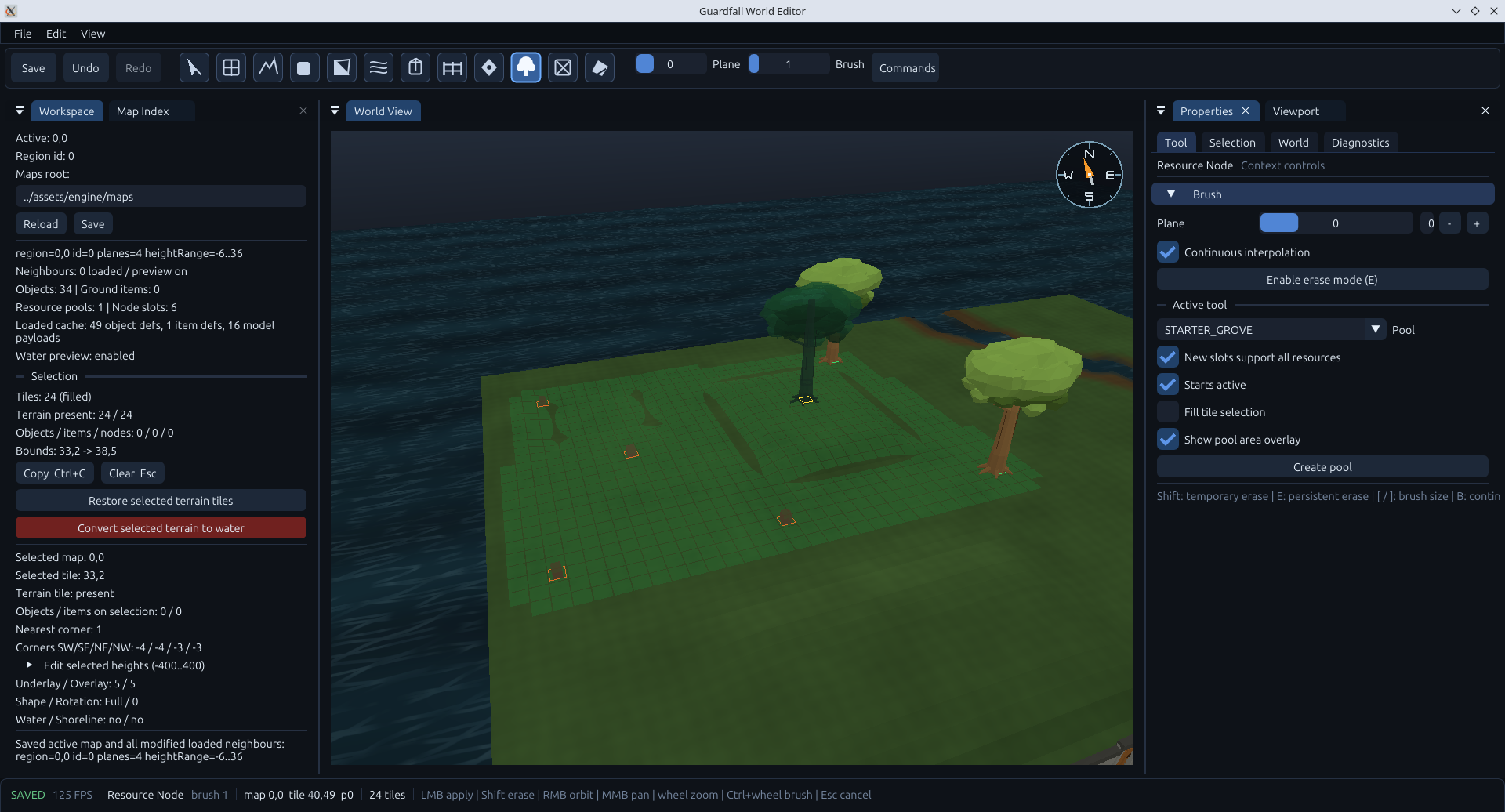
The first version of Resource Pool support has now been added to the Guardfall World Editor.
In the current development build, the green overlay shows resource locations connected to the same pool.
The green markers are only visible within the editor and will not appear to players in the finished game.
The editor allows us to define:
- which resource locations belong together;
- which resources each location can support;
- how many of each resource should remain active;
- which locations should begin active;
- how those resources are distributed throughout the area.
This means gathering areas can be designed alongside the world itself.
When creating a woodland, we can consider more than where individual trees should be placed. We can also consider:
- how far players should move;
- which paths connect different parts of the grove;
- which resources naturally belong in the area;
- which parts of the area are safest;
- how many players the location should comfortably support;
- what other content players may discover nearby.
The layout of the map and the behaviour of the gathering skill can be designed together.
The World Editor is therefore becoming more than a tool for terrain and scenery. It is beginning to define how players interact with the world.
An Experimental Direction
Resource Pools are still an experimental system.
The first Woodcraft implementation is working, Mining has begun using the same foundation, and Static Resources can now use behaviour distinct from pooled placements.
That does not mean every part of the design is final.
Pool sizes, active-node limits, success curves, shared-yield counts, respawn delays, passive compensation and gathering interactions will all require testing.
Some ideas may work well immediately.
Others may sound interesting on paper but become irritating when repeated over a longer session.
Those ideas will be adjusted or removed.
The purpose of discussing Resource Pools now is to show the direction we are currently exploring, not to promise that every detail will reach the finished game unchanged.
Guardfall is being developed openly, and that means some development blogs will discuss systems while they are still evolving.
A concept changing or disappearing after testing is not necessarily wasted work. Learning that a system does not improve the game is still useful.
What Comes Next?
The next stage is to continue testing Woodcraft and Mining across both pooled and static placements.
We need to evaluate:
- success rates at different skill levels;
- the effect of several players using one resource;
- timed depletion over longer sessions;
- shared-yield counts for Static Resources;
- respawn behaviour inside and outside pools;
- different pool sizes and active-resource limits;
- movement distances between active locations;
- future axe and pickaxe progression;
- beneficial and disruptive gathering interactions.
We also need to determine how well the passive compensation accounts for time spent moving between pooled resources.
Once the foundation has been tested more thoroughly through Woodcraft and Mining, it can begin supporting Fishing, Foraging and other gathering activities where the same structure is appropriate.
The goal is not to replace familiar gathering or force every player into a more active style of play.
It is to provide a choice.
Static Resources offer dependable, low-movement gathering with predictable shared yields.
Resource Pools encourage players to move through an area, learn the surrounding world and respond to occasional changes taking place around them.
Both have a place in Guardfall.