In Part One, we looked at the recent changes to Guardfall’s game client.
The game now has a structured fixed and resizable interface, Display UIs, paired inventories, a minimap, NPC dialogue, improved chat, player-status displays and the foundation of a proper combat shell.
Those changes have made Guardfall more readable and more recognisable as a game.
However, the work has not been limited to the client.
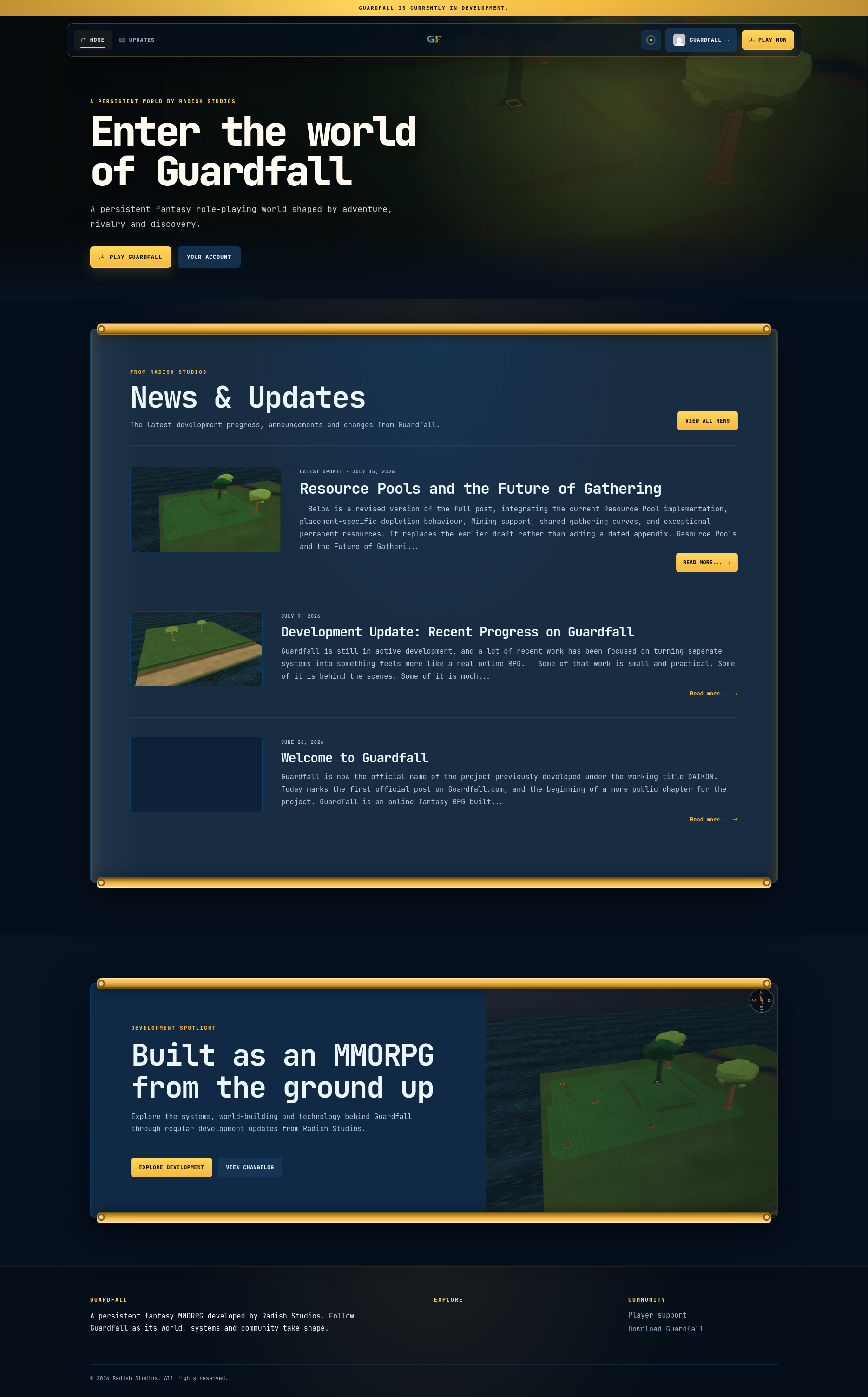
Guardfall.com has also been rebuilt around the game’s visual identity, while the wider development roadmap has been reorganised around the systems and tools needed to begin producing the Free-to-Play world.
Bringing Guardfall’s Identity to the Website
While the game client was developing a more recognisable interface, Guardfall.com was still visually separated from it.
The website already contained the correct information and basic structure, but it still carried more of Azuriom’s generic presentation than Guardfall’s own identity.
The recent website overhaul was therefore a targeted refinement rather than another complete redesign.
The current homepage structure has been kept:
- A lightweight floating header
- The main hero section
- News and Updates
- A development spotlight
- The footer
Development news remains close to the top of the page.
Guardfall.com is not intended to bury active development beneath several large generic marketing sections before players can see what is actually happening with the game.
Long-form development posts have also received specific attention.
Changes include:
- More readable article text
- Improved paragraph width
- Better spacing between sections
- Clearer headings
- Stronger separation between the article and page background
- Better mobile spacing
- Refined recent-post cards
- Consistent borders, buttons and panel surfaces
- A cleaner footer
The intention was not to turn the website into a generic promotional landing page.
It remains a home for development updates, project information and the Guardfall community.
Client Themes Come to Guardfall.com
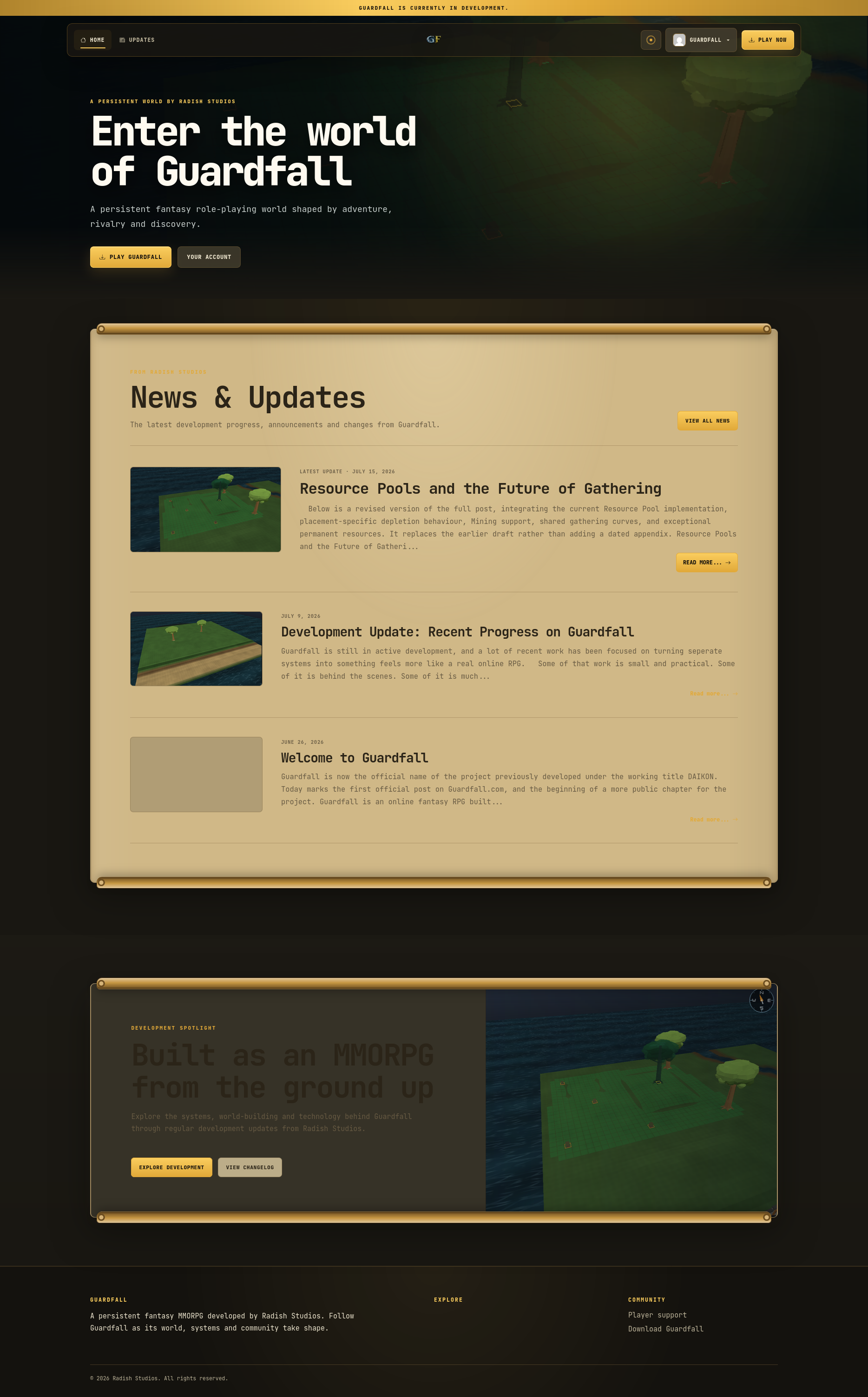
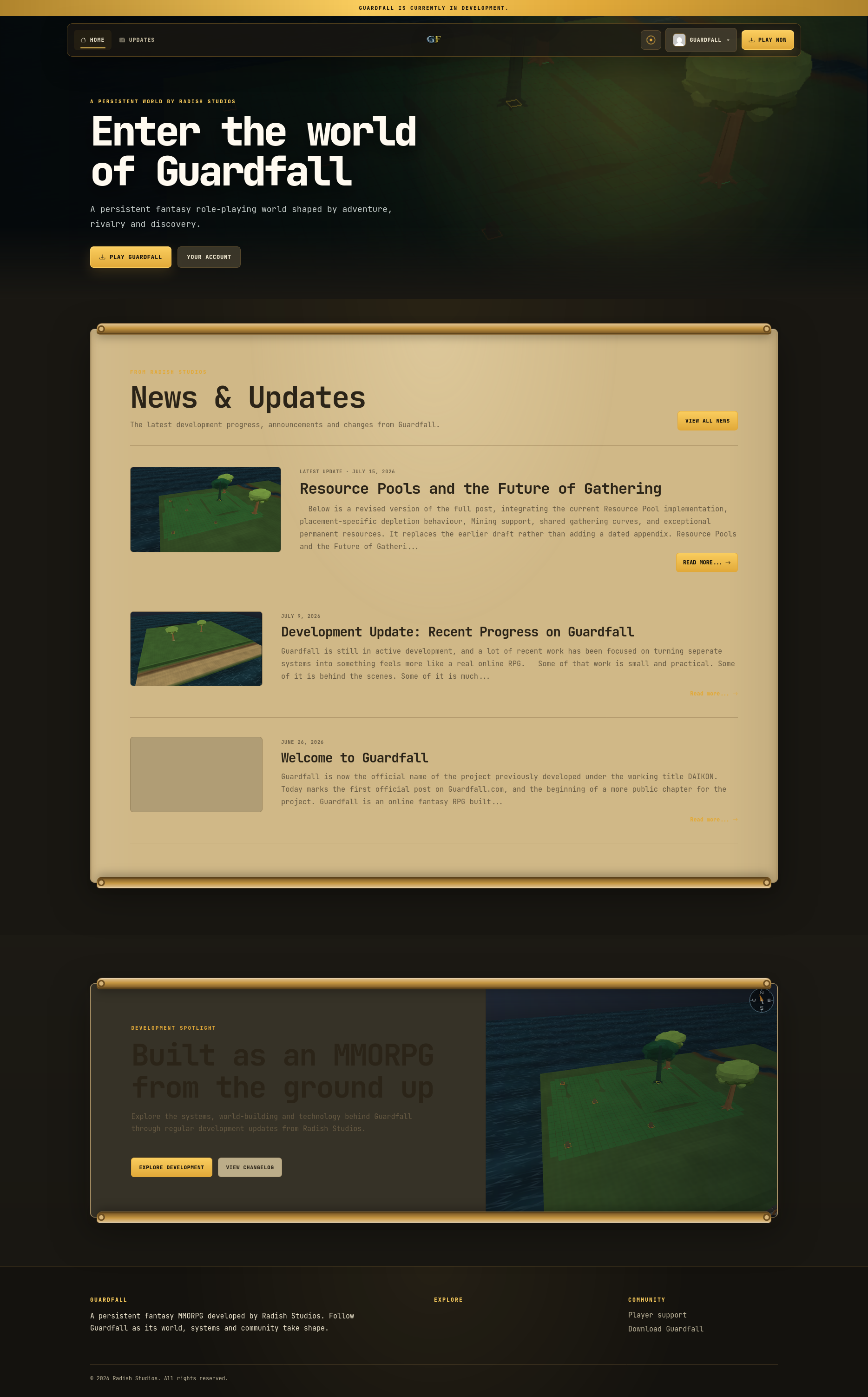
One of the largest website changes is the addition of the same principal appearance presets used by the client.
Guardfall currently has four shared themes:
- Guardfall Classic
- Guardfall Blue
- Classic Tan
- Midnight
These are not simply light and dark modes.
Each preset changes the palette used across the interface while keeping the underlying structure familiar.
Guardfall Classic
Guardfall Classic is the default project identity.
It uses the dark blue, subdued gold and cool panel colours associated with Guardfall’s logo, website artwork and current client shell.
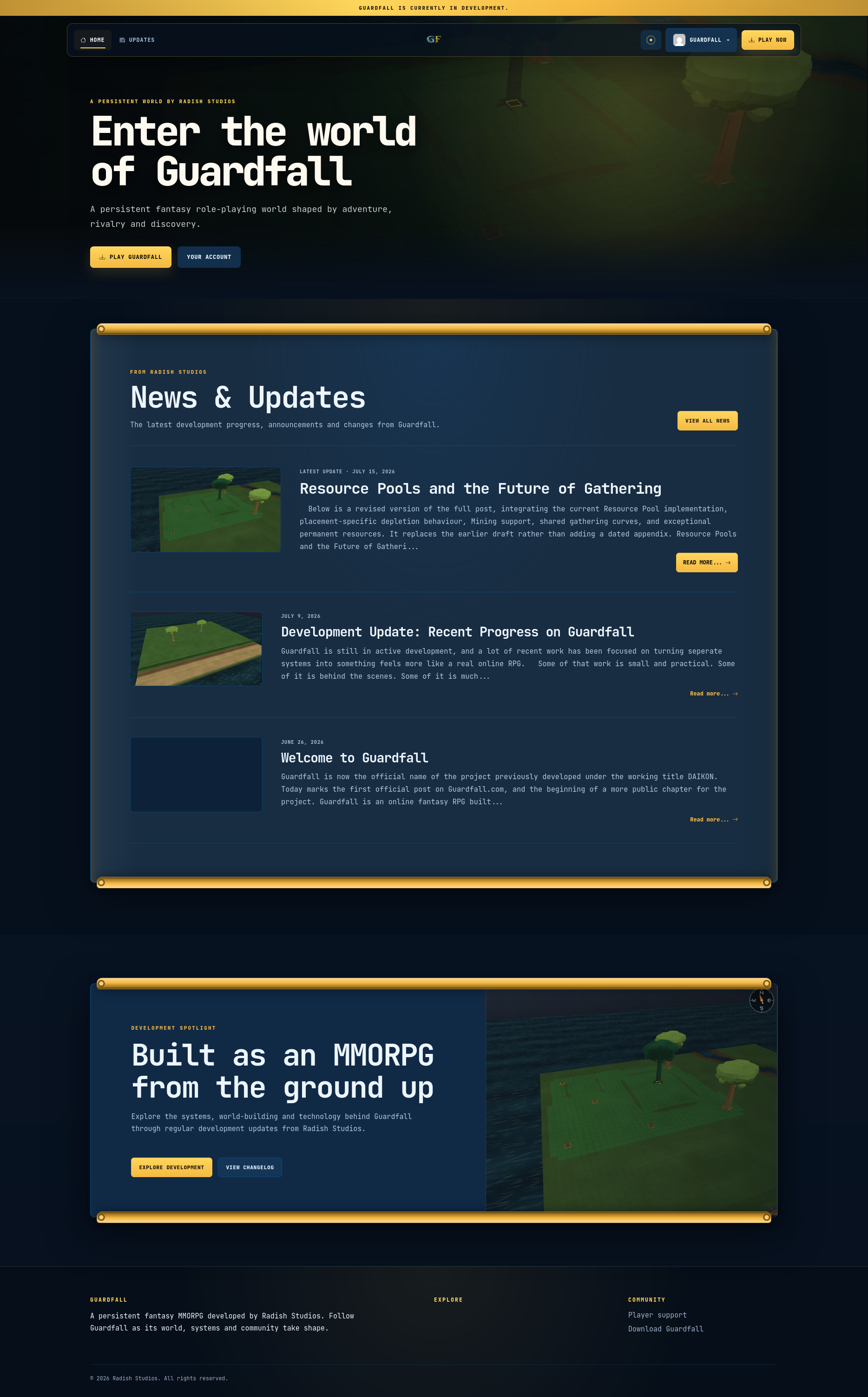
Guardfall Blue
Guardfall Blue uses a cooler and more strongly blue presentation.
It retains the same interface structure while shifting panels, highlights and controls towards the blue palette available in the game client.
Classic Tan
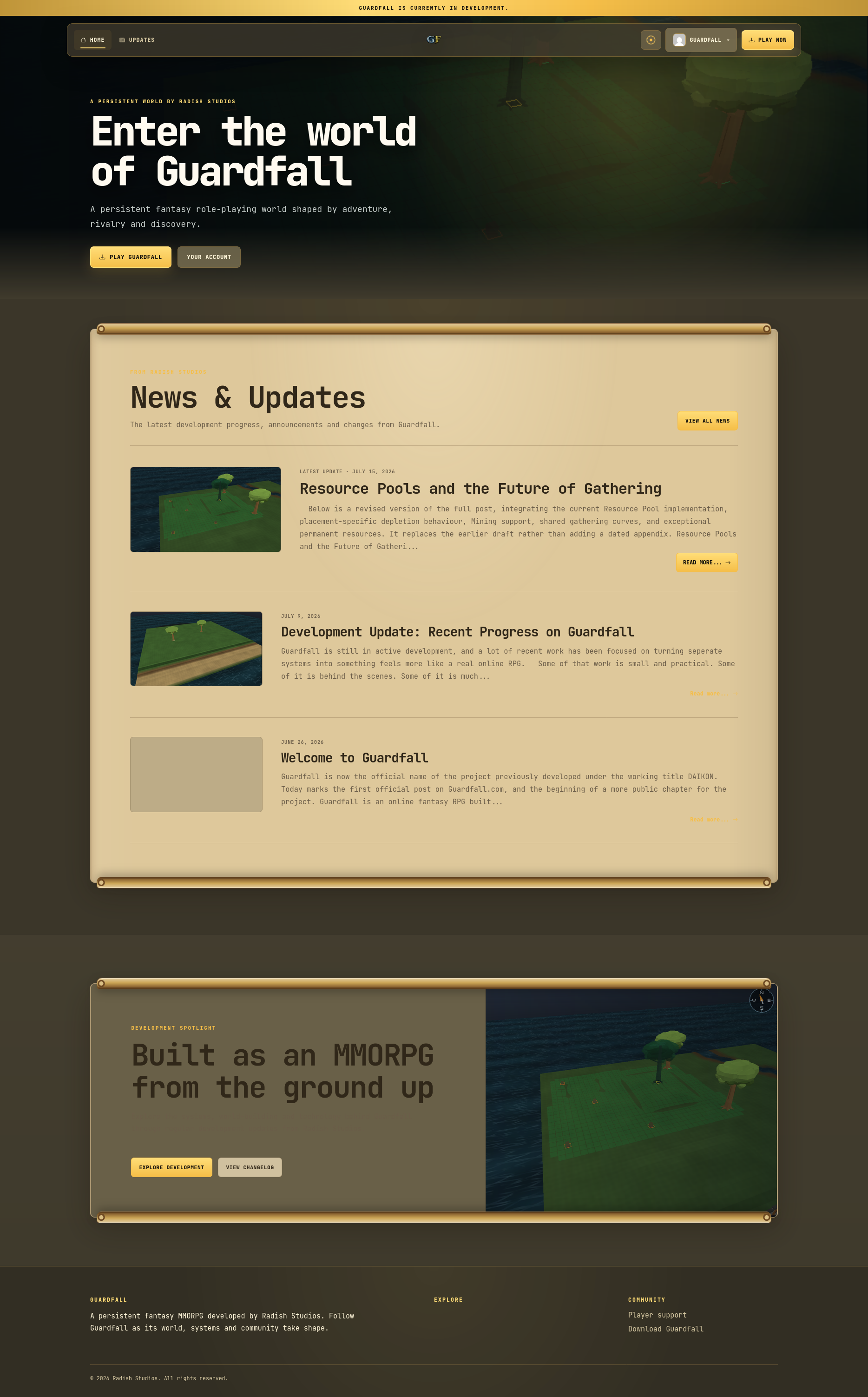
Classic Tan takes inspiration from the warmer interfaces used by older fantasy game clients.
It replaces much of the blue presentation with tan, brown and warm neutral surfaces while retaining Guardfall’s typography and overall layout.
Midnight
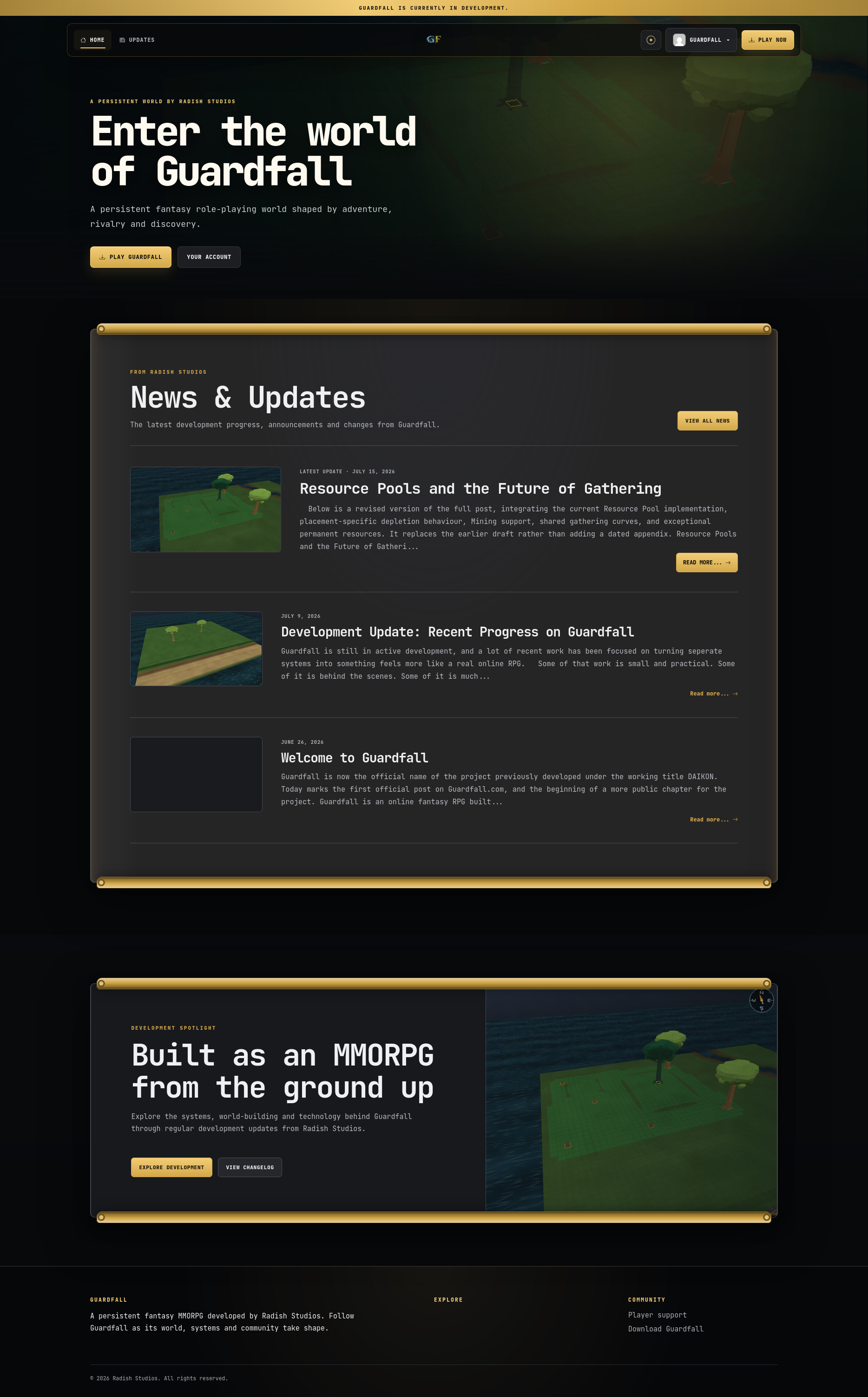
Midnight provides the darkest of the four presets.
It uses deeper background and panel tones for players who prefer a more restrained interface, while still maintaining enough contrast for cards, articles and navigation to remain clearly separated.
The old binary theme toggle has been replaced by an Appearance selector.
The selected preset is stored by the browser and applied before the page is displayed, reducing the chance of the wrong theme flashing briefly while the site loads.
An early attempt to move part of that persistence into the server-side website layer introduced instability and caused the site to fail for some visitors. That change was rolled back, while the visual improvements were retained.
The stable implementation keeps appearance selection on the browser side.
Supporting four complete palettes also exposed several sections that looked correct in one preset but not another.
A panel could have clear separation in Guardfall Classic but blend into the background in Midnight. Classic Tan required stronger surface distinction in several areas, while some buttons and cards initially remained too uniformly blue.
Those sections have now been refined so that each preset feels deliberate rather than being a basic colour replacement.
The website and client do not yet share one account-level theme setting, but they now use the same preset names and visual language.
That creates a clear path towards synchronising appearance preferences later.
Website Problems Solved during the Overhaul
As with the client, applying one consistent system exposed areas that had previously looked acceptable only in isolation.
Recent website refinements include:
- Improving long-form article readability
- Increasing mobile article spacing
- Strengthening Classic Tan surface separation
- Improving panel visibility in Midnight
- Applying themes consistently across cards, buttons and navigation
- Correcting sections that retained the wrong palette
- Preserving the existing homepage hierarchy
- Preventing theme selection from flashing the wrong preset during loading
- Rolling back an unstable server-side preference change
- Refining the “Built as an MMORPG from the ground up” section across every appearance preset
- Keeping development updates prominent rather than adding unnecessary marketing panels above them
The result is a website that feels much closer to the game it represents.
Updating the Development Roadmap
The recent client and website work also led to a wider review of Guardfall’s development roadmap.
The roadmap is not a strict Scrum schedule.
Dates and phases provide direction, but systems will be given the time they require. Work may move between stages when one foundation becomes more important than originally expected.
That has already happened with the development tools.
The Map Editor is now considered just as important to Guardfall’s next stage as the UI Editor.
Before the project moves heavily into producing the Free-to-Play world, the Map Editor needs to reach a point where it can be considered signed off for sustained world development.
The revised broad order is now:
- Final Map Editor pass and sign-off
- UI Editor completion
- Dialogue integration with persistent quest states
- Quest-system development
- Ranged combat
- Magic combat
- Melee attack animations
- Free-to-Play map design
- Free-to-Play quest planning
- A modular humanoid character model
- Continued world, character and equipment modelling
This is not intended to mean that no work can overlap.
Art, modelling, interface development and server improvements will continue throughout the project. The order reflects which foundations need to become dependable before later work can proceed efficiently.
Why the Map Editor Comes First
Every future town, dungeon, quest, road, forest and skilling area depends on the Map Editor.
Large-scale world production cannot begin efficiently if basic map-authoring work still requires frequent changes to the editor itself.
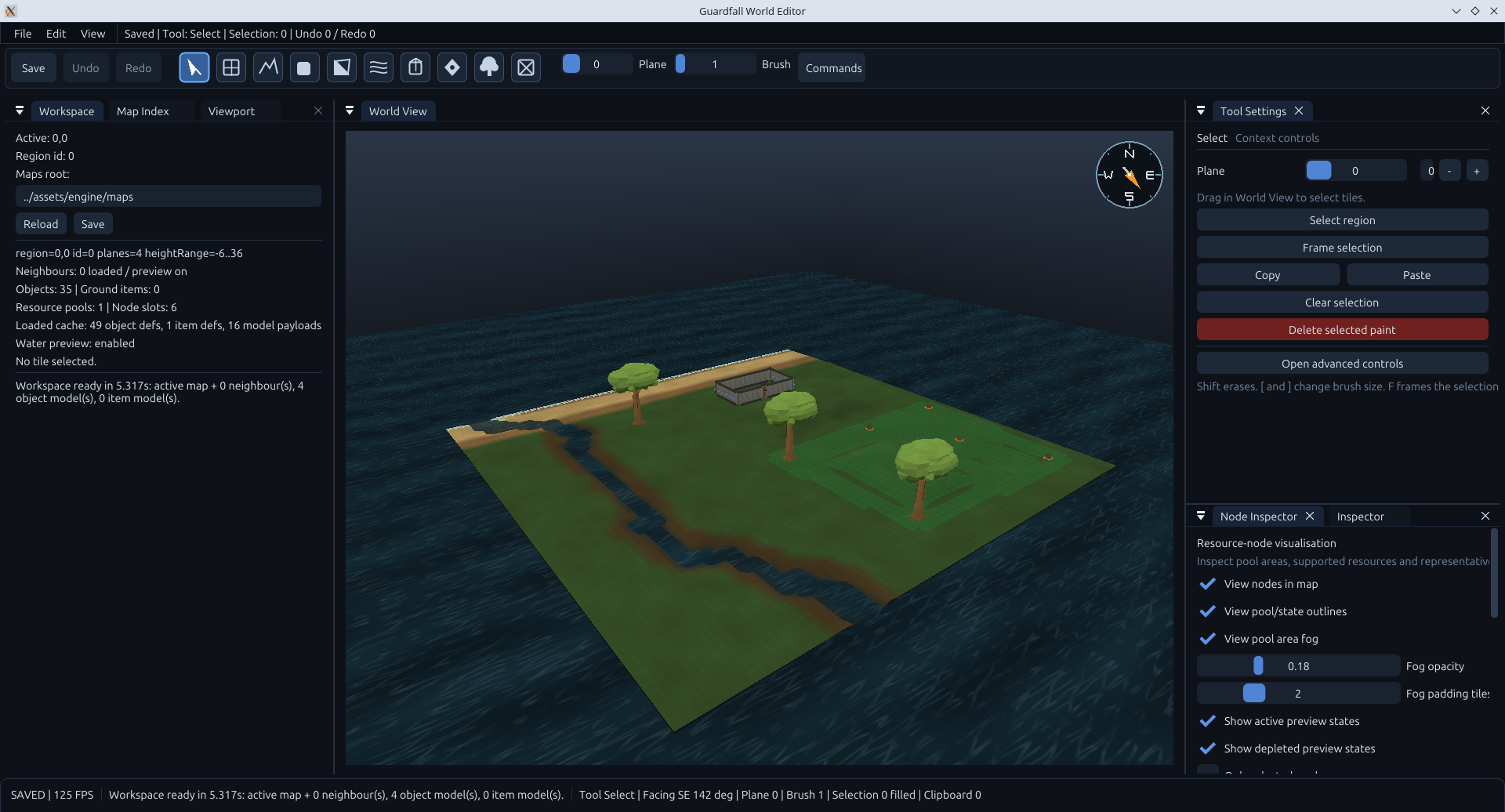
The final Map Editor phase therefore focuses on reaching a reliable production workflow.
That includes systems such as:
- Smooth terrain brushes
- Water and shoreline authoring
- Multi-region editing
- Neighbouring-region loading
- Region stitching
- Object placement
- Resource-node placement
- Movement and projection collision
- Connected-water collision tools
- Bridge flags and height handling
- Height editing
- Reliable cache packing
- Client and editor visual parity
- Lighting and environmental controls
The goal is not to finish every world-building feature Guardfall could ever need.
The goal is to reach the point where new areas can be created without repeatedly stopping to repair the underlying authoring workflow.
Once that point is reached, the Map Editor can be considered signed off for the current development stage.
Completing the UI Editor
The UI Editor follows the Map Editor in the revised roadmap.
Much of its foundation is already being built through the interface work covered in Part One.
The next stage will focus on making it practical to produce the larger number of gameplay interfaces required by quests, shops, banks, activities and future progression systems.
That includes:
- Reusable interface components
- Better preview and validation tools
- Consistent fixed and resizable behaviour
- Shared font and theme support
- Container authoring
- Tab, Display UI and full-screen interface creation
- More complete combat-shell authoring
- Improved dialogue presentation
The objective is the same as with the Map Editor: future content should be built through a dependable tool rather than through repeated one-off client changes.
From Dialogue to Quests
The dialogue system introduced in Part One establishes the basic conversation flow.
The next major step is connecting dialogue to persistent quest state.
NPCs need to remember what the player has done and respond accordingly.
Dialogue will eventually be able to change according to:
- Whether a quest has started
- Which objectives have been completed
- Items the player is carrying
- Skill requirements
- Previous decisions
- Alternative quest routes
- Whether the player has already received a reward
- Wider world conditions
Once that state system is dependable, work can move into the broader quest framework and the first properly structured Guardfall quests.
The intention is not to create a collection of isolated conversations.
Dialogue, objectives, rewards, world interactions and player choices need to operate as parts of one quest system.
Expanding Combat
Guardfall currently has the foundations of melee combat, including attacks, damage, hitsplats, health bars, retaliation and death handling.
The roadmap then expands combat through several major stages:
- Ranged combat
- Magic combat
- Melee attack animations
- Faith and spell interactions
- Combat-bar refinement
- Broader combat feedback
These systems need to be established before large amounts of quest and world content depend on them.
A quest involving a ranged enemy, magical encounter or equipment requirement should use proper gameplay systems rather than temporary scripted substitutes.
Designing the Free-to-Play World
Once the core tools, dialogue, quest and combat systems are ready, development can move more heavily into producing Guardfall’s Free-to-Play world.
The world will not be designed as a series of interchangeable settlements.
Major cities and towns need recognisable purposes.
Players should associate a location with particular activities, stories or opportunities.
A major city might function as:
- A social centre
- A trading hub
- A bank-standing skilling area
- A gateway to nearby quests
- A staging point for dungeons
Another settlement might be recognised for:
- Fishing
- Woodcraft
- Mining
- Farming
- Thieving
- Agility
- Combat
- A major quest series
Villages and smaller settlements can exist primarily for scenery, atmosphere and world-building.
Major towns and cities should give players practical reasons to return.
This approach helps areas remain relevant after their introductory quests have been completed.
A fishing town should continue to feel like a fishing town. A mining city should remain useful to miners. A regional capital should support the surrounding area rather than existing only as a backdrop.
Town Boards
The settlement-planning work has also introduced the concept of Town Boards.
A Town Board brings together the quests and local activities associated with a particular town.
Relevant skills remain trainable regardless of board progress.
A player does not need to complete a quest before they are allowed to fish, farm, mine or cut wood in the area.
Instead, completing local quests allows the associated activities to appear on that town’s board.
Once the required board objectives have been completed, the player unlocks a local reward for that session.
The current design provides a 10% XP bonus to relevant activities while the player remains inside the town’s defined map area.
The bonus lasts for the player’s current session until the normal reset.
For example, a fishing settlement might define the surrounding docks, fishing spots, farming patches and nearby trees as part of its local area. A player who completes the town’s board can then receive the bonus while training the relevant skills inside those designated tiles.
Leaving the town removes the local effect. Returning during the same eligible session allows the player to benefit from the completed board again.
This system is aimed particularly at players who enjoy long skilling sessions.
It gives committed players a reason to remain in one area for several hours while reinforcing the gameplay identity of each settlement.
The bonus does not replace ordinary progression and does not prevent anyone from using the local resources. It rewards players who complete the town’s content and then continue spending time there.
Building Characters for the World
Producing the Free-to-Play world will also require a more modular humanoid character system.
A reusable character foundation will support:
- Player equipment
- Different clothing sets
- Armour
- NPC variation
- Quest characters
- Town populations
- Character customisation
- Faster production of future equipment
Rather than creating every humanoid character as a completely separate model, bodies, equipment and clothing can be assembled from reusable parts.
Modelling will continue throughout development rather than beginning only after every technical system is complete.
Moving beyond Build 0.0.0
Guardfall has remained on build 0.0.0 while the project has been proving its basic architecture.
The aim is not to select a date and rename the next build 0.1.0 regardless of its condition.
The version should represent a genuine milestone.
A Guardfall 0.1.0 build should indicate that the foundations are stable enough for repeatable playable development.
That includes areas such as:
- Reliable login and world entry
- Stable connection and logout flows
- An established gameplay shell
- Functional interface opening and pairing
- Authoritative movement and combat
- Usable content-authoring tools
- Dialogue and early quest-state support
- A world that can be expanded without rebuilding its foundations every week
The roadmap provides direction towards that point, but it is not an arbitrary deadline.
Systems that require additional work will be given that work.
What Comes Next
The immediate development focus is now clearer.
The current interface work will continue to be tested and refined, particularly around:
- Item dragging
- Bank and paired-container interactions
- XP-drop behaviour
- The persistent XP bar
- Combat-bar controls
- Fixed and resizable layouts
- Settings and key bindings
- Dialogue presentation
- Status displays
The Map Editor will then receive its final production-focused pass before the wider UI Editor workflow is completed.
Dialogue will grow into persistent quest state, and the quest system will begin connecting NPCs, objects, items, objectives and rewards.
Combat will expand into ranged and magic, while the Free-to-Play world moves from broad planning into actual towns, roads, regions and quest areas.
Guardfall.com will continue to serve as the public record of that development.
Guardfall Is Beginning to Feel Connected
These two updates cover a wide range of work, but they represent one central change.
Guardfall is beginning to look and behave like one connected project.
The client now has a recognisable gameplay shell. Players can open contextual interfaces, manage paired containers, navigate through a minimap, speak to NPCs, read clearer text and receive more immediate progression feedback.
The website now carries the same visual presets and identity as the client.
The roadmap now reflects the tools and systems required to turn those foundations into a complete world.
Guardfall remains early in development, and there is still a substantial amount of work ahead.
The difference is that the foundations are no longer demonstrating isolated ideas.
They are beginning to support the game we have been planning.